Considering React Native for your next app?
Start with a free 30-minute conversation about your goals and constraints. Detailed analysis, solution design and estimates are scoped separately.
If your team already ships a React web app in TypeScript, React Native lets you share components, logic and engineers across web and mobile — one skill set, two platforms. UP2DATE builds production React Native apps with senior engineers, native modules where they are needed and store-ready delivery for EU and US companies.
A free 30-minute conversation to understand the situation and agree a next step. Detailed analysis is scoped separately.
Trusted by founders, scale-ups & enterprise teams











 Anteca
ConsultDesignBuildRun
This page assumes you already know what to build. Not sure yet? Start with a Product Discovery & Solution Blueprint or a Digital Process & Automation Assessment — sometimes the right answer is not new software.
Type-safe React Native apps built with modern patterns — hooks, context, functional components — and structured for long-term maintainability rather than quick prototypes.
When your team already has a React web app, we set up a shared logic layer — business rules, API clients, validation — that runs on both web and mobile, cutting duplication and keeping platforms in sync.
When React Native's JavaScript bridge is not enough — Bluetooth LE, background geolocation, custom camera pipelines, biometric auth — we write clean Swift or Kotlin native modules and wire them into the JS layer.
Inherited a React Native codebase with performance issues, dependency debt or an outdated architecture? We audit, triage and stabilise before extending — with an honest assessment of whether staying on RN is the right long-term call.
React Native's New Architecture (Fabric + JSI + TurboModules) is a significant shift. We plan and execute the migration incrementally, keeping your app live throughout and benchmarking performance gains at each step.
Full App Store and Play Store delivery — provisioning, signing, metadata, screenshots, review handling and staged rollouts. We own the pipeline so you focus on the product.
We work with both. Here is how we actually think about the choice — without the framework tribalism.
Comparable for most apps; heavy custom UI can show JS-thread overhead
Slightly edges ahead in animation-heavy or custom-paint scenarios
Leans on npm and the React community — vast, familiar if you know JS
pub.dev is smaller but curated; both are mature for production use
Wins clearly if your team already writes React and TypeScript
Better when starting fresh or when web-code sharing is not needed
Uses native widgets — feels right per platform, harder to pixel-match across
Renders identically on every device; easier to match a custom design system
We recommend RN when your context says so — React team, web code sharing
Our default for new projects without a strong RN context
React Native with TypeScript as the foundation. Expo for projects that benefit from managed workflow. Swift and Kotlin for native module bridges when the platform demands it. Firebase for analytics, crash reporting and remote config.
We do not sell React Native to every mobile project. If Flutter fits better — pixel-perfect custom UI, no React web context, greenfield project — we say so before any scope is signed.
No. If the scope is clear, we start from a normal first conversation. When the problem or the return is still fuzzy, a short paid assessment settles what to build — or whether to build at all.
The honest answer depends on your team and your codebase. If you already have React and TypeScript engineers, or you need to share significant logic with a React web app, React Native is the natural fit — your team is productive from day one and the web/mobile boundary stays thin. If you are starting from scratch, want pixel-perfect custom UI, or have no existing JavaScript investment, Flutter is usually the stronger foundation. We give you a straight recommendation in a 30-minute call after understanding your context.
Yes, within limits that are worth being honest about. Business logic, API clients, data models, validation schemas and state management (Zustand, Redux) can be shared almost directly. UI components cannot — React Native uses native primitives, not DOM elements. The practical gain is real but varies by app: on a typical B2B product with a rich API layer, shared logic can reduce duplication by 30–50%. We map out the shared surface in discovery before committing to a scope.
Yes. We start with a performance and architecture audit — JS thread bottlenecks, excessive re-renders, bridge-crossing frequency, outdated native modules and dependency vulnerabilities. From there we prioritise fixes by user impact and address them incrementally so the app stays live. We also give you an honest view of whether the issues are solvable in React Native or whether a migration plan makes more sense long-term.
React Native's JS bridge lets you call into platform code when the JavaScript layer cannot do the job. We write a Swift module (iOS) or Kotlin module (Android) — or both — that exposes the native API as a clean JavaScript interface. With the New Architecture, this happens through JSI (JavaScript Interface) and TurboModules, which removes the async bridge overhead and makes native calls significantly faster. The module is tested in isolation before being integrated into the React Native layer.
React Native releases major versions roughly every six months, and the New Architecture (Fabric renderer + JSI + TurboModules) is now the stable default. Long-term maintenance means keeping the React Native version current, auditing third-party libraries for New Architecture compatibility, migrating custom native modules from the old bridge to TurboModules, and running the New Architecture in interop mode during the transition to avoid big-bang rewrites. We set up automated upgrade checks in CI and plan each major upgrade as a scheduled work item — not an emergency.
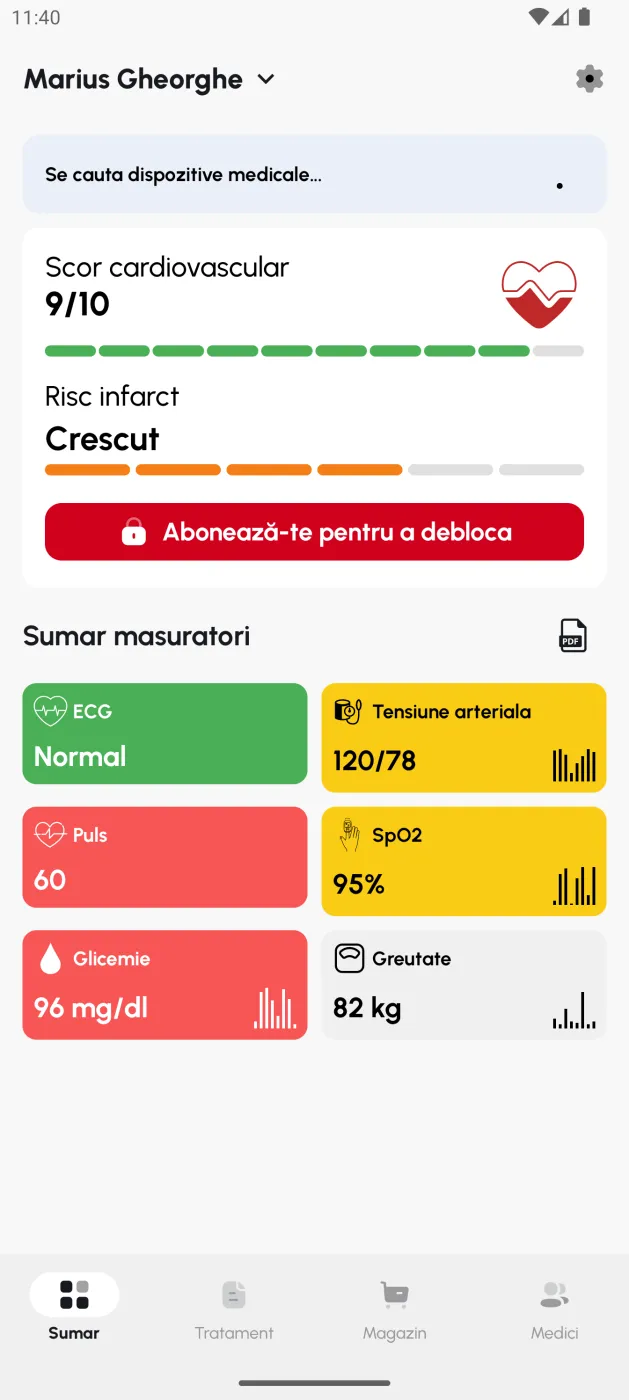 Healthcare
Native iOS & Android apps for patients plus a web platform for doctors, with BLE integration for smart medical devices and real-time monitoring.
Start with a free 30-minute conversation about your goals and constraints. Detailed analysis, solution design and estimates are scoped separately.