Custom software development
We build custom software for companies in Romania, the EU and the US: internal systems, operational platforms and integrations. The PPC Romania project illustrates business travel requests, approvals and ERP/HR data connections.
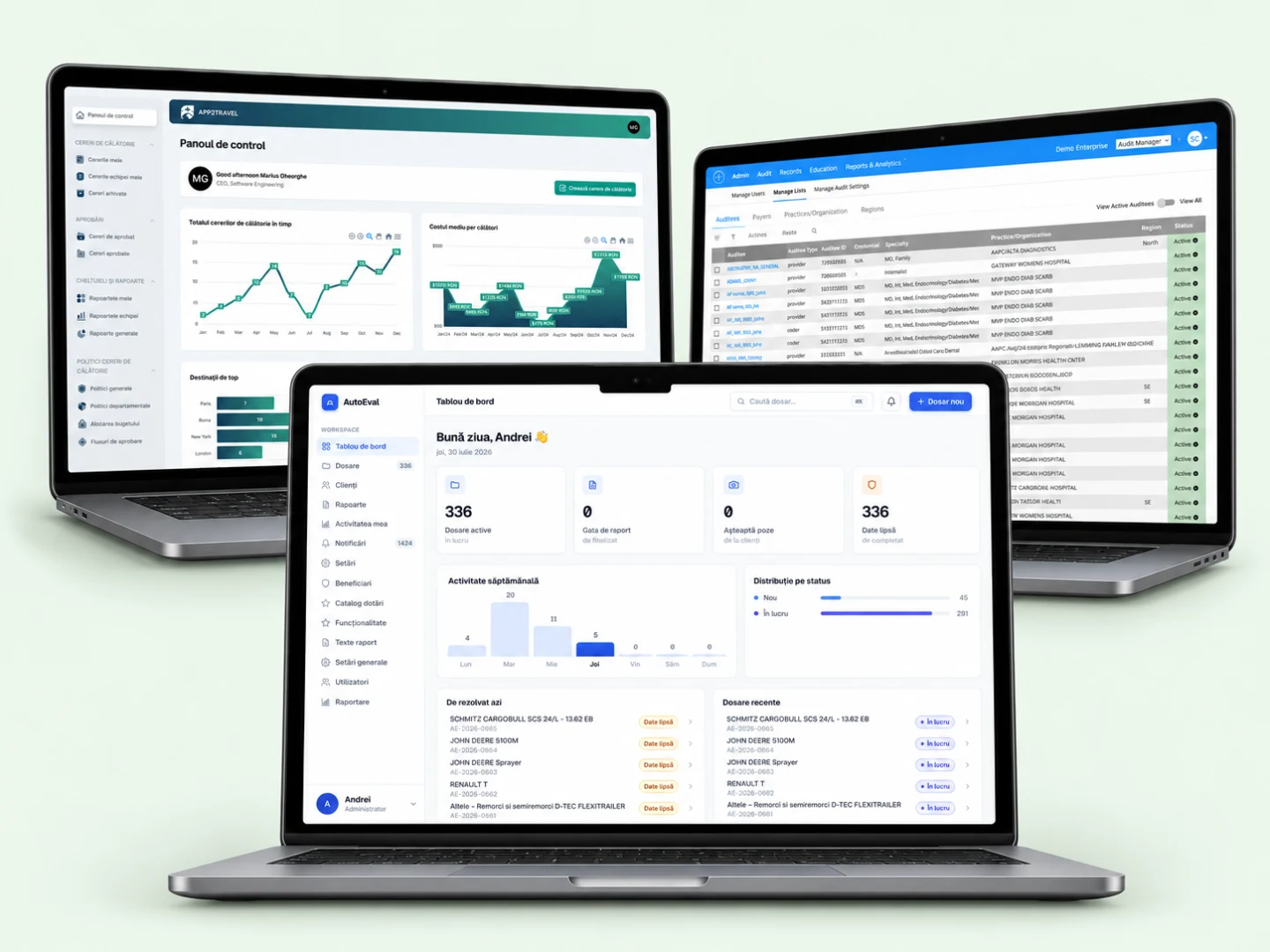
From our project portfolio








What can we build for your business?
Web platforms & portals
Customer-facing web applications, internal portals and dashboards — built for scale, accessibility and long-term maintainability.
Internal systems
Back-office tools, ERP extensions and workflow automation that reduce manual work and surface the right data at the right time.
Integrations & APIs
REST and event-driven integrations between your core systems and third-party services — reliable, versioned and fully documented.
Legacy modernization
Incremental re-architecture of aging codebases — strangler-fig patterns, domain extraction and database migrations with zero-downtime deploys.
Security & compliance
GDPR-aligned data handling, role-based access control, audit trails and penetration-test-ready codebases for regulated industries — including custom healthcare software for regulated providers.
Long-term maintenance
Post-launch SLAs, performance monitoring, dependency upgrades and feature evolution — we stay as a partner, not a one-off vendor.
What budget and timeline should you plan for?
How much does custom software development cost?
UP2DATE's indicative ranges are €8,000–€16,000 for a focused MVP and €16,000–€60,000 for a broader product, excluding VAT. Scope, integrations, migration and dependencies determine the proposal. Infrastructure, licenses and support are budgeted separately.
How long does a typical custom software project take?
A first working release generally takes 3–6 months depending on scope. We use short sprints with weekly demos, so you see real progress from week two — not just a big reveal at the end.
How will we work together?
We agree the scope and responsibilities up front, then build, review and launch in stages.
- 1
Discovery and project scope
We start with your objectives, users and existing systems. We define the first release, integrations, acceptance criteria and the basis for an estimate.
- 2
Design and architecture
We map user workflows, design the interfaces and choose the architecture around your requirements and the systems we need to connect.
- 3
Build and review in iterations
We develop in short sprints and review working versions with your team. Testing and feedback guide the next steps.
- 4
Launch, handover and support
We agree the release plan, data migration and access to code, accounts and documentation. Monitoring, maintenance and further improvements follow the support agreement.
Which technologies fit your project?
We default to .NET on the backend and React / Next.js on the frontend — proven at scale, easy to hire for long-term. Azure and AWS for cloud; PostgreSQL for data.
We pick the right tool for longevity, not the one that is trending. Every stack choice is justified against your specific scale, team and maintenance horizon.
What else should you know before we start?
Can we start without technical specifications?
Yes. We start with your business objectives and existing systems. We define requirements and architecture with your team, then deliver in stages. If the scope is already clear, we can start directly with implementation.
Who owns the code and intellectual property?
The proposal and contract define rights to custom code, transfer conditions and access to repositories, accounts and documentation. Third-party and open-source components retain their licenses; we identify them to clarify dependencies.
What happens after the software launches?
We offer tiered support SLAs covering bug fixes, security patches and performance monitoring. Many clients keep us on for feature evolution — monthly retainers or sprint-by-sprint. Either way, we hand over thorough documentation and runbooks so your internal team can take over if you prefer.
Ready to build your custom software?
Start with a free 30-minute conversation about your goals and constraints. Detailed analysis, solution design and estimates are scoped separately.