PPC Romania: trip approvals from 3 days to 30 minutes
An enterprise travel-management platform for 2,000+ employees — automated multi-level approvals, ERP/HR integrations and real-time cost visibility. Trip processing went from 3 days to 30 minutes.
Trusted by founders, scale-ups & enterprise teams













 Anteca
PPC: connecting the travel approval process
An enterprise travel-management platform connects approvals, employee travel and operational systems. The useful starting question: where do handoffs, re-entry and missing information slow a process down?
For a similar challenge, assess the complete workflow and its integrations before deciding which application to build.
Digital Process & Automation AssessmentPPC Romania, an industrial manufacturer with 2,000+ employees, ran business-trip management as a manual, multi-level process. A single request could take up to three days to clear — routed by email and spreadsheet through several approvers, with no central view of who had approved what or what it would cost.
At that headcount, the cost wasn't just the delay. It was finance having no real-time visibility into travel spend, policies that were almost impossible to enforce consistently, and senior staff losing hours chasing approvals instead of doing their jobs. The brief was to turn a fragmented, paper-speed process into a fast, auditable, self-service one:
- Cut multi-day approvals to minutes without removing the right oversight
- Give finance real-time visibility into travel cost as it's committed
- Encode the travel policy so compliance is automatic, not manual
- Integrate with the existing ERP and HR systems instead of duplicating data
- Handle multi-level approval chains that vary by role, cost and destination
- Replace manual reporting and reconciliation with live dashboards
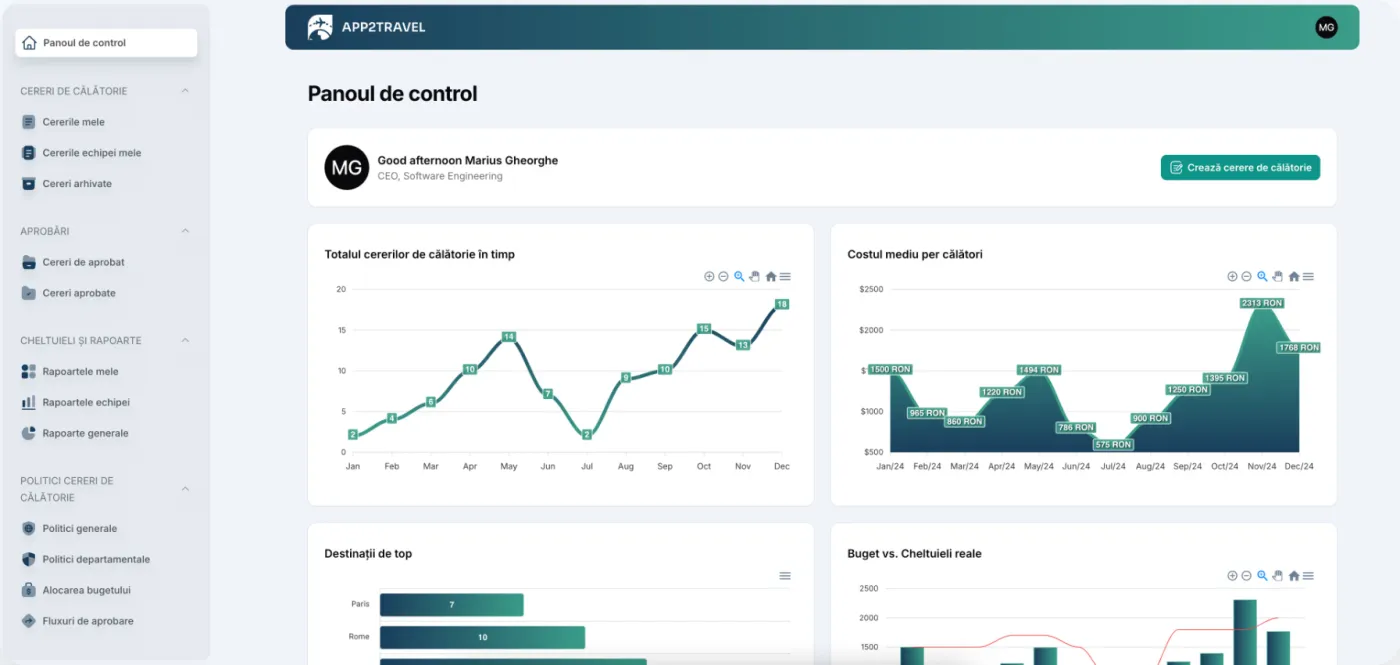
We built a centralised, enterprise web platform that owns the entire trip lifecycle — request, approval, booking, cost capture and reconciliation — and connects to the systems PPC already runs.
Configurable approval workflows. Instead of a fixed chain, approvals are driven by rules: role, cost thresholds, destination and policy all decide who needs to sign off, in what order. Routine, in-policy trips move automatically; only the exceptions need a human decision — which is what collapsed a three-day cycle to roughly thirty minutes.
Policy encoded, not enforced by hand. The travel policy lives in the system. Out-of-policy requests are flagged or blocked at submission with a clear reason, so compliance is the default path rather than an after-the-fact audit.
ERP and HR integration. The platform reads org structure, cost centres and employee data from the existing HR/ERP systems over their APIs and writes committed costs back — one source of truth, no duplicate data entry.
Real-time cost visibility. Finance sees travel spend as it's committed, by department, cost centre and period, on live dashboards — not in a month-end spreadsheet.
Built to scale across 2,000+ employees. The architecture handles concurrent requests across the organisation without the bottlenecks of the old manual chain.
Stack: React, Node.js, PostgreSQL and REST integrations with the client's ERP and HR systems.
Processing a corporate trip dropped from three days to about 30 minutes, 80% of the workflow became automated, and travel costs fell 25% — with finance gaining full, real-time visibility into spend.
Beyond the headline numbers, the platform removed an entire category of manual operational work: no more email approval chains, no more spreadsheet reconciliation, no more guessing whether a trip was in policy. Approvers act only on the exceptions that need judgement, employees self-serve in-policy travel in minutes, and finance closes the period from live data.
It's a clean example of what UP2DATE does: take a slow, manual, multi-system operational process and turn it into a fast, integrated, auditable one.
Frequently asked questions
How did trip approvals drop from 3 days to 30 minutes?
A digital travel-management workflow for 2,000+ employees replaced email chains with rule-based approvals: standard requests are approved automatically, exceptions are routed to the right manager — 80% of the workflow now runs without manual steps.
Where do the 25% travel-cost savings come from?
Travel policies are enforced automatically at booking time, spend is visible in real time, and fewer out-of-policy exceptions slip through — the savings come from prevention, not after-the-fact audits.
Does it integrate with existing company systems?
Yes — the platform plugs into the company's existing internal systems and workflows, so employees request trips in one place and finance gets structured data instead of scattered emails.
More case studies
Facing a similar challenge?
Discuss your context in a free initial conversation. We will clarify the next step; your scope and expected outcomes need their own assessment.
Request an initial conversation
A free 30-minute conversation to understand the situation and agree a next step. Detailed analysis is scoped separately.